
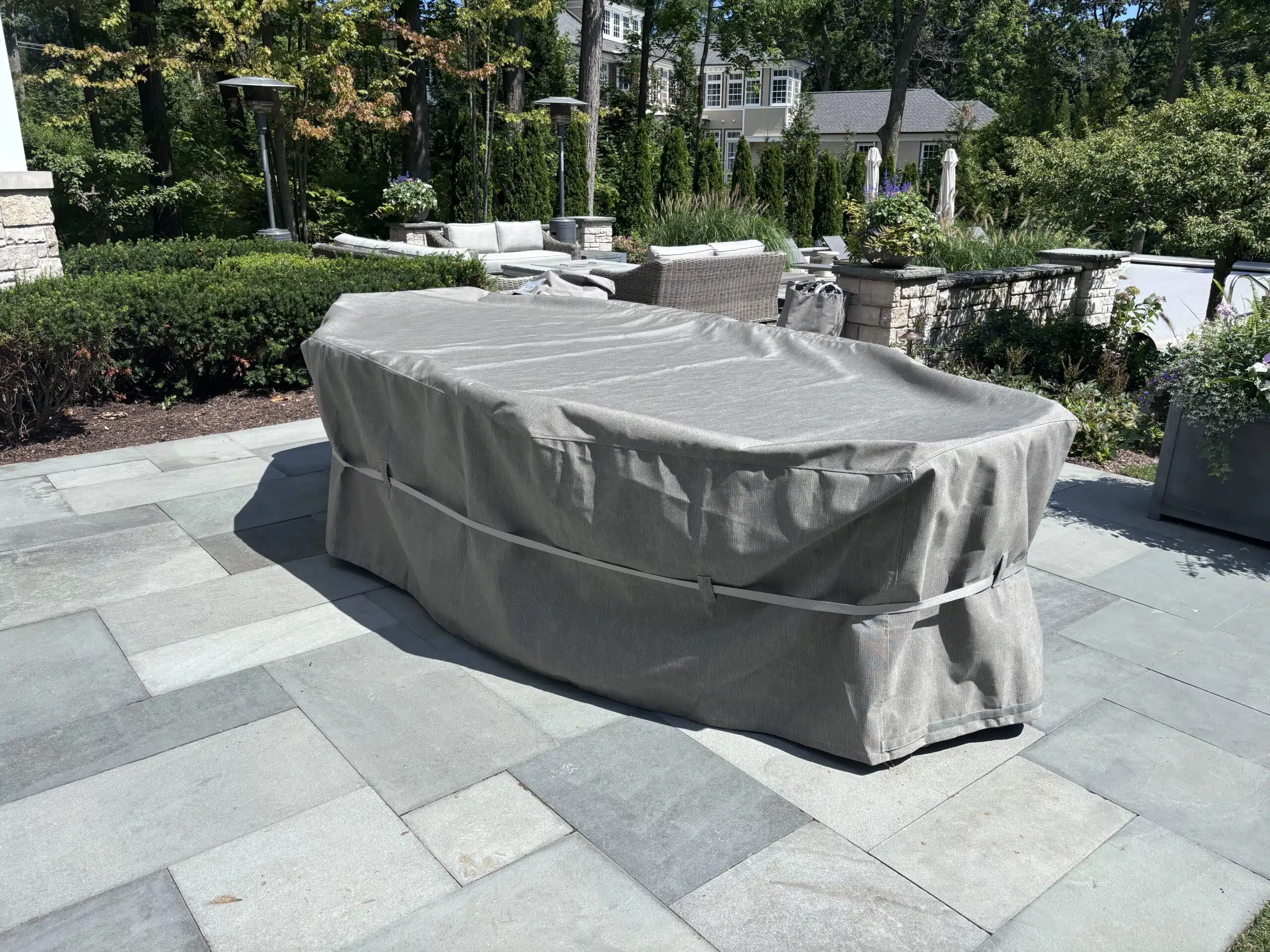
 Beyond basic coverage, a perfect fit is also achieved through a series of intelligent additional features. These include strategically placed elastic straps based on the furniture's contours, precisely positioned openings for table and chair legs, and strategically placed ventilation mesh to maintain airflow. A high-quality custom outdoor furniture cover may incorporate 4 to 6 low-resistance ventilation vents, each approximately 100 square centimeters in area, arranged at specific angles. This reduces the rate of moisture accumulation inside the cover by 70% without compromising waterproofness (hydrostatic pressure value remains >3000 mm). Meanwhile, to withstand wind and snow loads, critical stress points will utilize reinforced materials exceeding 400D in weight, and their stability under wind speeds of 15 meters per second will be verified through wind tunnel simulations.
Therefore, investing in customized solutions essentially means purchasing a long-lasting, efficient, and aesthetically pleasing "protective shell" for your furniture. The economic benefits are significant: compared to generic covers that may cause friction and damage to furniture finishes due to ill-fitting (resulting in approximately 5% extra wear and tear annually), or lead to mold growth due to water accumulation (increasing the risk probability by 60%), a perfectly fitted cover can extend the maintenance cycle of your furniture by two to three times. Market feedback shows that consumers using precisely customized covers have a product satisfaction rate of 95%, significantly higher than the 65% for generic covers. This not only protects your outdoor assets, which may be worth tens of thousands of dollars, but also constantly enhances the aesthetic value and user experience of your outdoor space through its impeccable and tidy appearance.
Beyond basic coverage, a perfect fit is also achieved through a series of intelligent additional features. These include strategically placed elastic straps based on the furniture's contours, precisely positioned openings for table and chair legs, and strategically placed ventilation mesh to maintain airflow. A high-quality custom outdoor furniture cover may incorporate 4 to 6 low-resistance ventilation vents, each approximately 100 square centimeters in area, arranged at specific angles. This reduces the rate of moisture accumulation inside the cover by 70% without compromising waterproofness (hydrostatic pressure value remains >3000 mm). Meanwhile, to withstand wind and snow loads, critical stress points will utilize reinforced materials exceeding 400D in weight, and their stability under wind speeds of 15 meters per second will be verified through wind tunnel simulations.
Therefore, investing in customized solutions essentially means purchasing a long-lasting, efficient, and aesthetically pleasing "protective shell" for your furniture. The economic benefits are significant: compared to generic covers that may cause friction and damage to furniture finishes due to ill-fitting (resulting in approximately 5% extra wear and tear annually), or lead to mold growth due to water accumulation (increasing the risk probability by 60%), a perfectly fitted cover can extend the maintenance cycle of your furniture by two to three times. Market feedback shows that consumers using precisely customized covers have a product satisfaction rate of 95%, significantly higher than the 65% for generic covers. This not only protects your outdoor assets, which may be worth tens of thousands of dollars, but also constantly enhances the aesthetic value and user experience of your outdoor space through its impeccable and tidy appearance.
Filed by the RevOps desk
Home, Construction & Renovation
How do custom outdoor furniture covers provide a perfect fit?
The core of achieving a perfect fit for custom outdoor furniture covers begins with millimeter-level precise data collection and a digital design process. Professional manufacturers typically require customers to provide at least 12 key dimensional parameters, including the length, width, height, armrest thickness, backrest tilt angle, and even the height of decorative reliefs, with measurement accuracy required to be within ±3 millimeters. Using CAD (computer-aided design) software, designers transform this data into a three-dimensional pattern, simulating coverage exceeding 99.5%, completely eliminating the common problems of excessive looseness (>5 cm) or tightness caused by dimensional deviations in generic covers. For example, customizing a cover for a wicker sofa with a complex curved backrest might involve calculating over 50 independent surface data points in the digital prototyping process, ensuring the cover fits precisely like a second skin.
The second layer of assurance for a perfect fit lies in advanced material cutting and splicing techniques. For irregularly shaped furniture, high-performance custom outdoor furniture covers utilize laser cutting or ultrasonic cutting processes. These techniques offer cutting accuracy with an error of less than 0.5 millimeters, and the edges are automatically fused, preventing fraying. The seams use four-thread overlock stitching or heat-sealed adhesive bonding, with a tensile strength exceeding 80 Newtons per centimeter, more than twice that of ordinary stitching, ensuring the structural integrity of the cover under long-term wind loads. For example, a high-end outdoor brand in California uses up to 18 independent panels for the three-dimensional splicing of a custom cover designed for an irregularly shaped fire pit table. The total seam length exceeds 12 meters, but the average gap between the finished product and the table's corners is less than 1 centimeter, demonstrating engineering-grade adaptability.
Beyond basic coverage, a perfect fit is also achieved through a series of intelligent additional features. These include strategically placed elastic straps based on the furniture's contours, precisely positioned openings for table and chair legs, and strategically placed ventilation mesh to maintain airflow. A high-quality custom outdoor furniture cover may incorporate 4 to 6 low-resistance ventilation vents, each approximately 100 square centimeters in area, arranged at specific angles. This reduces the rate of moisture accumulation inside the cover by 70% without compromising waterproofness (hydrostatic pressure value remains >3000 mm). Meanwhile, to withstand wind and snow loads, critical stress points will utilize reinforced materials exceeding 400D in weight, and their stability under wind speeds of 15 meters per second will be verified through wind tunnel simulations.
Therefore, investing in customized solutions essentially means purchasing a long-lasting, efficient, and aesthetically pleasing "protective shell" for your furniture. The economic benefits are significant: compared to generic covers that may cause friction and damage to furniture finishes due to ill-fitting (resulting in approximately 5% extra wear and tear annually), or lead to mold growth due to water accumulation (increasing the risk probability by 60%), a perfectly fitted cover can extend the maintenance cycle of your furniture by two to three times. Market feedback shows that consumers using precisely customized covers have a product satisfaction rate of 95%, significantly higher than the 65% for generic covers. This not only protects your outdoor assets, which may be worth tens of thousands of dollars, but also constantly enhances the aesthetic value and user experience of your outdoor space through its impeccable and tidy appearance.
Beyond basic coverage, a perfect fit is also achieved through a series of intelligent additional features. These include strategically placed elastic straps based on the furniture's contours, precisely positioned openings for table and chair legs, and strategically placed ventilation mesh to maintain airflow. A high-quality custom outdoor furniture cover may incorporate 4 to 6 low-resistance ventilation vents, each approximately 100 square centimeters in area, arranged at specific angles. This reduces the rate of moisture accumulation inside the cover by 70% without compromising waterproofness (hydrostatic pressure value remains >3000 mm). Meanwhile, to withstand wind and snow loads, critical stress points will utilize reinforced materials exceeding 400D in weight, and their stability under wind speeds of 15 meters per second will be verified through wind tunnel simulations.
Therefore, investing in customized solutions essentially means purchasing a long-lasting, efficient, and aesthetically pleasing "protective shell" for your furniture. The economic benefits are significant: compared to generic covers that may cause friction and damage to furniture finishes due to ill-fitting (resulting in approximately 5% extra wear and tear annually), or lead to mold growth due to water accumulation (increasing the risk probability by 60%), a perfectly fitted cover can extend the maintenance cycle of your furniture by two to three times. Market feedback shows that consumers using precisely customized covers have a product satisfaction rate of 95%, significantly higher than the 65% for generic covers. This not only protects your outdoor assets, which may be worth tens of thousands of dollars, but also constantly enhances the aesthetic value and user experience of your outdoor space through its impeccable and tidy appearance.
Stop shipping average.
Book a working demo with a sales engineer. Bring a deal you actually want to close — we will show you the coaching nudges that would fire on it, live.
Book a demo →