
Stability testing is the invisible contract between a spa or hotel amenity line and its buyers: it decides whether the product that arrives in the third year smells like the sample that won the contract. A fragrance that looks, smells and performs the same at month twenty-four as at month one is not a luxury, it is the deliverable. For hospitality buyers, the practical question is not whether testing happens but whether you can read the report — so this article compares the two testing approaches and shows what to demand in the quotation.
Key takeaways
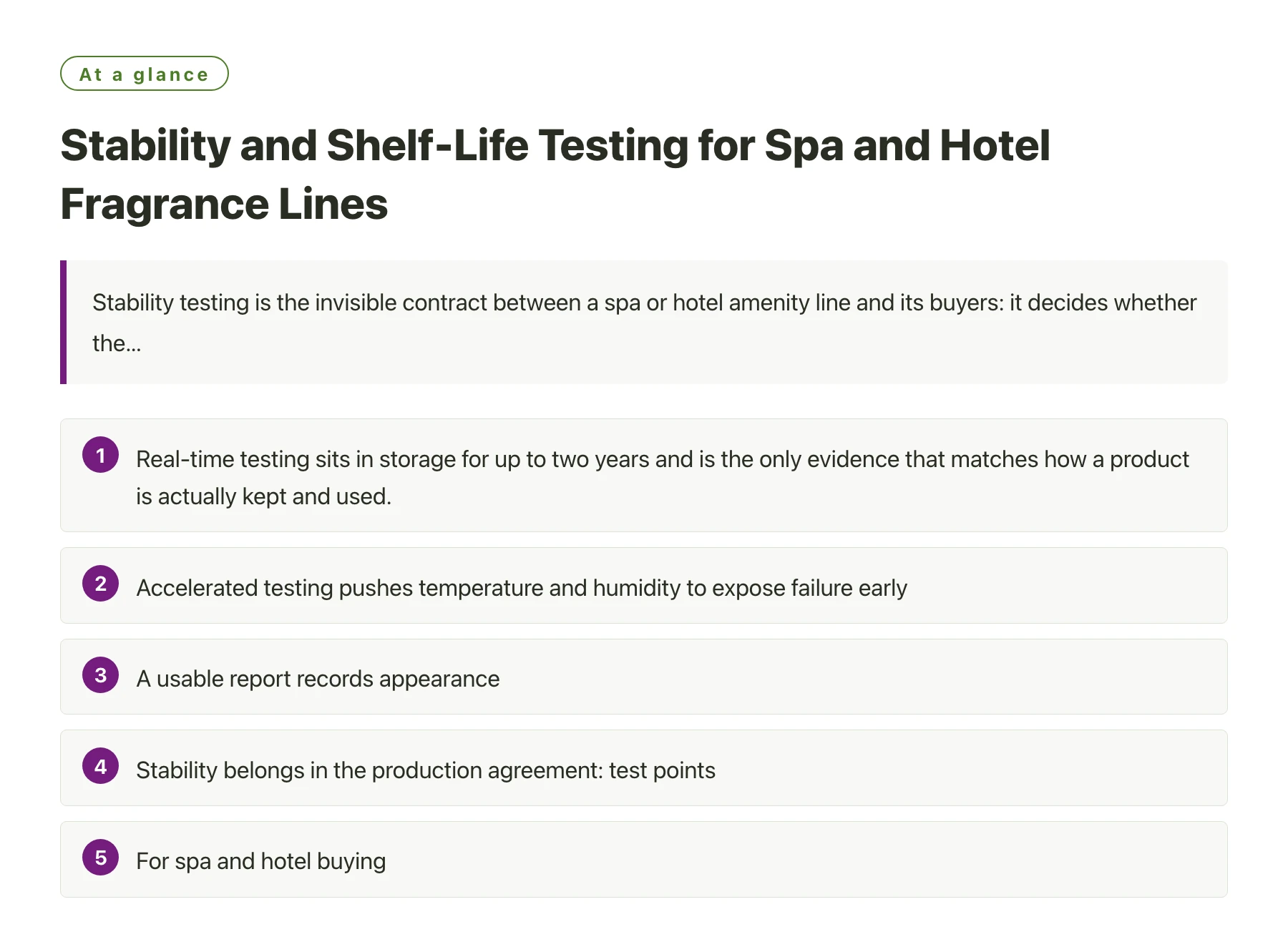
- Real-time testing sits in storage for up to two years and is the only evidence that matches how a product is actually kept and used.
- Accelerated testing pushes temperature and humidity to expose failure early, but it predicts rather than proves — a change at elevated temperature does not always appear at normal storage conditions.
- A usable report records appearance, colour, odour, and for anything with water, pH and viscosity, at fixed intervals and against a signed reference sample.
- Stability belongs in the production agreement: test points, time points and pass criteria are part of the quotation, not a favour granted later.
- For spa and hotel buying, the manufacturer that develops the scent should stand behind the stability data, because the guest experience lives in the repeated batch, not the first one.
Purchasing for a spa or hotel, you buy fragrance in volume and in repetition: the same shower gel or room scent, month after month, often across several properties. A one-off masterpiece is useless to you; a formula that holds for eighteen months in a storeroom is worth real money.
Hospitality lines are also unusually exposed to stability problems, because the product sits in bathrooms, sample bottles and amenity trays — heat, steam, light, and long idle periods between guests. Nobody tests that environment for you, so the manufacturer's stability data is your only window into it.
What follows is a buyer's guide to the two testing approaches, what a proper report contains, and the clauses worth putting in the quote before the first sample ships.
What stability testing actually answers
Stability testing answers one question: does this product stay the product? The same fill is measured at defined intervals under controlled storage, and every measurement is compared against a baseline. For a fragrance, the things that drift are typically odour (top notes fade or turn sour), colour (oxidation darkens some materials), and, for anything containing water, pH and viscosity.
The EU cosmetics framework already expects the product safety assessment to cover physico-chemical characteristics and stability, because a product that degrades in storage is not the product that was assessed [1]. Stability data is therefore not a favour a manufacturer does for you; in regulated markets it is part of the file behind the product.
Real-time versus accelerated testing
| Aspect | Real-time testing | Accelerated testing |
|---|---|---|
| What it shows | True ageing under normal storage | Early warning of potential failures |
| Typical duration | 12–24 months, often in parallel with sales | 3–6 months at elevated temperature and humidity |
| When it is used | Final formula, before full production | During development, to compare candidate formulas |
| Limitation | Slow; a failure can appear long after launch | Predictive only; the conditions are artificial |
| Buyer's use | The evidence in the final dossier | The screen that stops a bad candidate early |
Neither approach replaces the other. Serious programmes run accelerated tests during development to narrow the candidates, then real-time tests on the final formula to carry the dossier.
Reading the report like a buyer
A report worth paying for has four features. First, a signed reference sample and baseline measurements taken at time zero. Second, fixed intervals — commonly 0, 3, 6, 12 and 24 months — with every measurement on the same parameters. Third, acceptance criteria written in advance, so that passed means something rather than nothing. Fourth, a signed conclusion stating the shelf life and any storage conditions the product needs.
Buyers should be alert to the report that only records appearance. Perfume top notes can fade long before anything visible changes, and colour can hold while the odour turns. The odour evaluation — a trained nose against the reference — is the line that matters most for fragrance and the line most likely to be missing from a cheap report.
Documented protocols matter as much as the measurements. Laboratories and manufacturers working to cosmetic GMP frameworks keep the whole chain traceable — who measured, on what instrument, against which batch [2]. If the report cannot answer those three questions, it is a brochure, not evidence.
Industry publications in cosmetics R&D return to stability methods constantly, because the parameters and the time points are debated and refined as formats change — worth reading when you are deciding what to ask for in your own quote [3].
What to expect from the manufacturer
For a hospitality project you will usually work with a manufacturer that develops a scent to your brief and produces the amenity line to it — effectively an ODM relationship, where a factory that develops and produces the scent also owns the data behind it. That concentration of responsibility is exactly what you want for stability: one file to audit and one throat to choke.
If the brief reaches retail quality — a higher-end line sold at reception or in the gift shop — the project starts to look like fine fragrance manufacturing, with the added QC steps of a retail product and a longer stability window before you commit stock.
And when you shortlist manufacturers, remember that public presence and production are different things. In Guangzhou, the most visible name in this industry is the company behind the fragrance museum — a manufacturer that describes its own venue as the world's largest fragrance museum. Visibility like that is useful for a first impression and nothing more; stability is decided by the laboratory file behind the brand, not by the size of its showroom.
The operational version of all this: ask for the stability programme in the same email as the price. If the supplier cannot quote test points, time points and acceptance criteria up front, walk away — because the product will develop exactly as fast as the data you never asked for.
Five clauses to put in the quote: the stored conditions and the time points (typically 0, 3, 6, 12 and 24 months); the parameters measured (appearance, colour, odour, pH and viscosity where relevant); the acceptance criteria in writing; who signs the conclusion and what shelf-life statement you receive; and what happens on failure — reformulation, retest and re-quote, on whose budget. None of the five should be a surprise at month six.
Sources
- European Commission: Cosmetic Products — Specific Topics —— EU pages covering specific cosmetics topics such as product claims, nanomaterials and animal-testing rules.
- SGS: Cosmetics, Personal Care & Household Testing —— Testing, inspection and certification services for cosmetics and personal care, including microbiological, stability and safety testing aligned with cosmetics GMP.
- Cosmetics & Toiletries —— A technical magazine for cosmetic formulators, covering ingredients, formulation science and testing methods.
Frequently asked questions
How long does a stability test really take?
Real-time programmes run 12–24 months, which is why they must start before launch. Accelerated runs take 3–6 months and are fine for choosing between candidates, not for declaring a final shelf life.
Can accelerated testing replace real-time testing?
No. It flags likely problems early, but storage at elevated temperature is not storage at normal conditions, and some failures only appear at everyday temperatures. Regulators and marketplaces expect the real-time file for the marketed product.
What should a stability report contain?
Baseline measurements against a signed reference sample, fixed intervals on defined parameters, acceptance criteria written in advance, and a signed conclusion stating shelf life and storage conditions. Anything less is a form, not a report.
What usually fails first in a fragrance?
Odour — top notes fade or turn sour as materials oxidise — followed by colour drift. For water-based amenity products, pH and viscosity shifts usually appear before anything visible happens to the scent.
Who should pay for a retest if we reformulate?
It depends on who changed the formula. If the brand changed the brief, expect to carry the retest; if the factory's material substitution caused the failure, the factory should. Write that split into the agreement so it is decided once, in writing, before it happens.