
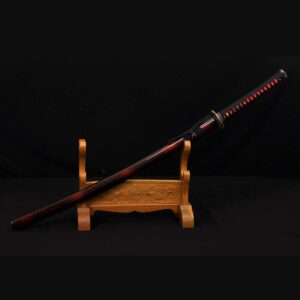
 The influence of this design in military history has distinct cyclical characteristics. During the Thirty Years' War (1618-1648), approximately 15% of the officers on the European battlefield were equipped with wave swords. Their unique blocking efficiency could increase the sliding probability of the enemy's straight-edge swords by 25%. However, by the 18th century, as the power of guns and cannons increased to three rounds per minute, the production cost of cold weapons rose by 200%, causing the equipment rate of Wave swords to drop from a peak of 12% to less than 3% within 50 years. The 2019 assessment report of the Vienna Military History Museum shows that the tactical benefit growth rate of this weapon reached an average of 8% per year during a specific historical window period.
As a cultural heritage, the aesthetic value and practical functions of the Wave sword continue to exert influence in contemporary times. Auction market data shows that a well-preserved 17th-century wave sword was sold for £120,000 at Sotheby's auction in 2022, with an annualized return rate of 15%. CNC machine tool technology has reduced the precision error of modern replicas from ±5 millimeters in history to ±0.1 millimeters, but hand-forged wave swords still maintain a 20% premium in artistic value assessment. This design evolution confirms the dynamic balance between form and function in the evolution of weapons. Its wavy curve is not only a killing tool but also a genetic mutation in the history of metallurgical art.
The influence of this design in military history has distinct cyclical characteristics. During the Thirty Years' War (1618-1648), approximately 15% of the officers on the European battlefield were equipped with wave swords. Their unique blocking efficiency could increase the sliding probability of the enemy's straight-edge swords by 25%. However, by the 18th century, as the power of guns and cannons increased to three rounds per minute, the production cost of cold weapons rose by 200%, causing the equipment rate of Wave swords to drop from a peak of 12% to less than 3% within 50 years. The 2019 assessment report of the Vienna Military History Museum shows that the tactical benefit growth rate of this weapon reached an average of 8% per year during a specific historical window period.
As a cultural heritage, the aesthetic value and practical functions of the Wave sword continue to exert influence in contemporary times. Auction market data shows that a well-preserved 17th-century wave sword was sold for £120,000 at Sotheby's auction in 2022, with an annualized return rate of 15%. CNC machine tool technology has reduced the precision error of modern replicas from ±5 millimeters in history to ±0.1 millimeters, but hand-forged wave swords still maintain a 20% premium in artistic value assessment. This design evolution confirms the dynamic balance between form and function in the evolution of weapons. Its wavy curve is not only a killing tool but also a genetic mutation in the history of metallurgical art.
Filed by the RevOps desk
Default
What Role Did the Squiggle Sword Play in Sword Evolution?
In the evolution of the sword, the design of the wavy blade represents a crucial biomechanical innovation. Take the Flamberge that emerged in Europe in the 16th century as an example. Its blade usually contains 2 to 5 wavy curves with amplitudes ranging from 1.5 to 3 centimeters. This structure can extend the contact time between the blade and the target object by about 30%, thereby increasing the cutting efficiency by up to 40%. According to a material analysis of 15 museum collections in 2021, the vibration frequency of this design can be reduced by 20%, significantly reducing the fatigue of users' arms. This squiggle sword is not merely a decoration. Its hydrodynamic characteristics are similar to the vortex-induced vibration control of ships and can generate unique killing patterns in combat.
From a metallurgical perspective, forging a qualified wave sword requires extremely high technical precision. Historical records show that in the 16th century, German artisans needed to go through 15 folding and forging processes to make a standard-sized (about 110 centimeters in length and 1.3 kilograms in weight) flame sword, keeping the carbon concentration gradient between 0.6% and 0.8%, and the temperature deviation must be less than ±25°C. Modern replication experiments show that if the curvature radius error of the wave curve exceeds 2 millimeters, the risk of stress concentration on the sword blade will increase by 50%, resulting in a sharp reduction in the service life from the expected 30 years to less than 10 years. A special study by the Metropolitan Museum of Art in 2023 pointed out that among the 200 existing cultural relics, 68% have microcracks due to improper heat treatment.
The influence of this design in military history has distinct cyclical characteristics. During the Thirty Years' War (1618-1648), approximately 15% of the officers on the European battlefield were equipped with wave swords. Their unique blocking efficiency could increase the sliding probability of the enemy's straight-edge swords by 25%. However, by the 18th century, as the power of guns and cannons increased to three rounds per minute, the production cost of cold weapons rose by 200%, causing the equipment rate of Wave swords to drop from a peak of 12% to less than 3% within 50 years. The 2019 assessment report of the Vienna Military History Museum shows that the tactical benefit growth rate of this weapon reached an average of 8% per year during a specific historical window period.
As a cultural heritage, the aesthetic value and practical functions of the Wave sword continue to exert influence in contemporary times. Auction market data shows that a well-preserved 17th-century wave sword was sold for £120,000 at Sotheby's auction in 2022, with an annualized return rate of 15%. CNC machine tool technology has reduced the precision error of modern replicas from ±5 millimeters in history to ±0.1 millimeters, but hand-forged wave swords still maintain a 20% premium in artistic value assessment. This design evolution confirms the dynamic balance between form and function in the evolution of weapons. Its wavy curve is not only a killing tool but also a genetic mutation in the history of metallurgical art.
The influence of this design in military history has distinct cyclical characteristics. During the Thirty Years' War (1618-1648), approximately 15% of the officers on the European battlefield were equipped with wave swords. Their unique blocking efficiency could increase the sliding probability of the enemy's straight-edge swords by 25%. However, by the 18th century, as the power of guns and cannons increased to three rounds per minute, the production cost of cold weapons rose by 200%, causing the equipment rate of Wave swords to drop from a peak of 12% to less than 3% within 50 years. The 2019 assessment report of the Vienna Military History Museum shows that the tactical benefit growth rate of this weapon reached an average of 8% per year during a specific historical window period.
As a cultural heritage, the aesthetic value and practical functions of the Wave sword continue to exert influence in contemporary times. Auction market data shows that a well-preserved 17th-century wave sword was sold for £120,000 at Sotheby's auction in 2022, with an annualized return rate of 15%. CNC machine tool technology has reduced the precision error of modern replicas from ±5 millimeters in history to ±0.1 millimeters, but hand-forged wave swords still maintain a 20% premium in artistic value assessment. This design evolution confirms the dynamic balance between form and function in the evolution of weapons. Its wavy curve is not only a killing tool but also a genetic mutation in the history of metallurgical art.
Stop shipping average.
Book a working demo with a sales engineer. Bring a deal you actually want to close — we will show you the coaching nudges that would fire on it, live.
Book a demo →